This is the teacher’s message to you, to be read when you have
enrolled to SISU and
received the entry code.
Before sending the code, I have stored your student number, name, and email to this learning platform called Harpo. When registering to Harpo you will have to invent a pseudonym for yourself to recognize and for others to see. Without registering or login you can see the front page with links to the course handbook and the exam material site Maso.
You must study the handbook first. You must get familiar with the somewhat unconventional arrangements first, especially the multitude of parts through which you will gather your learning. Most importantly, you must understand that in this course, the scheduling of your cyber security studies now completely depends on yourself. I will give feedback to your:
questions and comments that you post in Maso.
report on infosec procedures that improve availability in your digital life.
essays: two large texts toward the end of your course.
Exam 2 comments: fully optional for passing the exam, and Exam 2 itself is optional.
Exam 3 answers: mandatory for passing, of course, but Exam 3 is optional.
news tweets, but only if I see that they are not good.
direct messages, like questions, comments or error reports.
but I will not prompt you for any of these. Also, you can pass the course without any communication with me after entry. Just take Exam 1 (with exercises), or go on with an Exam 2, where you do not submit comments. Grade 3 is obtainable automatically, “in secrecy”. That can happen also very quickly if you already have some background on cyber security. And the same is even more true about grade 1. But if you want to check-out without Exam 3 or with a grade below 5, you must notify me.
Please note that on this course, only a small quantity of material is directly given for you to handle the exercises and exams. Mostly you need to find out solutions on your own. The difficulty is not in finding suitable information, but scheduling your work in such a way that you can make continuous progress. Please plan your work on the course and also note the expiry rules in course handbook.
After reading the handbook, the document Maps & Lists might be the next reading for you, unless you want to go directly to the exercises in Harpo. If you want to start with a somewhat longer and more comprehensive text, read the "NIST Intro", but check instructions for it in the Maps & Lists first. And if you want a really complete but still (mainly) introductory text, download the CyBOK v1.1, also presented in the Maps & Lists. That is the text the parallel Finnish course is mainly built on.
For questions that are broader or deeper than course matters, and beyond my expertise, I draw your attention to the page Forms of support for studying and well-being. It links to various sources of support in a wide spectrum of questions concerning learning, studying, well-being, health, life management etc. Cyber security itself or this course may also cause a need for support beyond my capabilities, for example:
A distressing experience of cyber insecurity in general, or a specific situation such as:
becoming a victim of identity theft, scam or cyberbullying (e.g. targeting). These links give you advice and you may find others in your own language. The faculty services have a different focus, but do not hesitate to consult them if your ability to study is affected.
Difficulties in interpreting multiple choice questions. For such cases there are even specialists at TAU that handle individual arrangements.
Now, start checking what is available and required, but note that there are limits in exercise attempts and practice exams. In general, please do not try too experimental things with Harpo or Maso, and report to me if you meet any bugs or even typos around there. As a last thing now, for future: even in the case you want to pass the course with exams only, you need to remember your Harpo credentials to access the exams. Memorize the password before stepping into the Exam classroom.
--
Tiina
Your teacher
How to approach Cyber Security 1
Mastering self-paced self-study is not self-evident but requires self-discipline. Here are some self-help tips.
The course structure allows several ways to study and pass it. It may take some time to find those structures that fit your way of learning. If you know your learning style, check here what might be good for you especially in the beginning of the learning process:
If you are a
"TL;DR" person, or in a hurry for some other reasons, stop reading after this sentence and begin collecting 30 points for grade 1, with at least 10 from Exam 1, and the rest from exercises accessible on the left column of the Harpo main page.
"experimental" learner, begin collecting points from all available sources, trying links in Harpo and Maso. Just don't waste too many attempts in the exercises by guesswork. And if you take Exam 1 without properly preparing for it, do not complete it with a passing grade that is below your expectations – instead "correct" it to a fail and try again later.
"planning" or "calculating" person, achieving best when you have a design with numbers and dates in front of you, consider adapting the schedule to your resources and goals. Besides adjusting also the calculator to your grade goal, keep a goal and learning diary in your profile page.
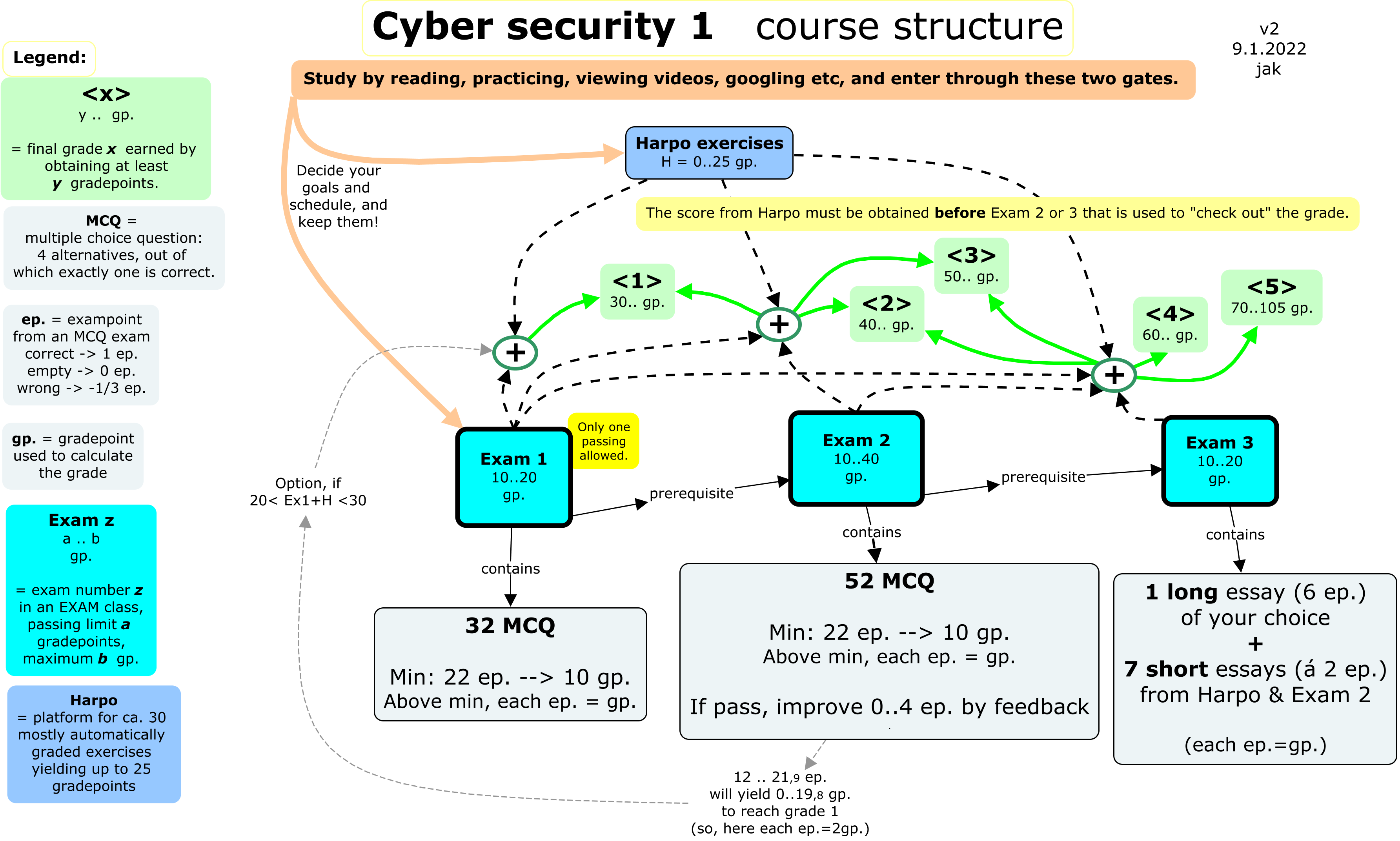
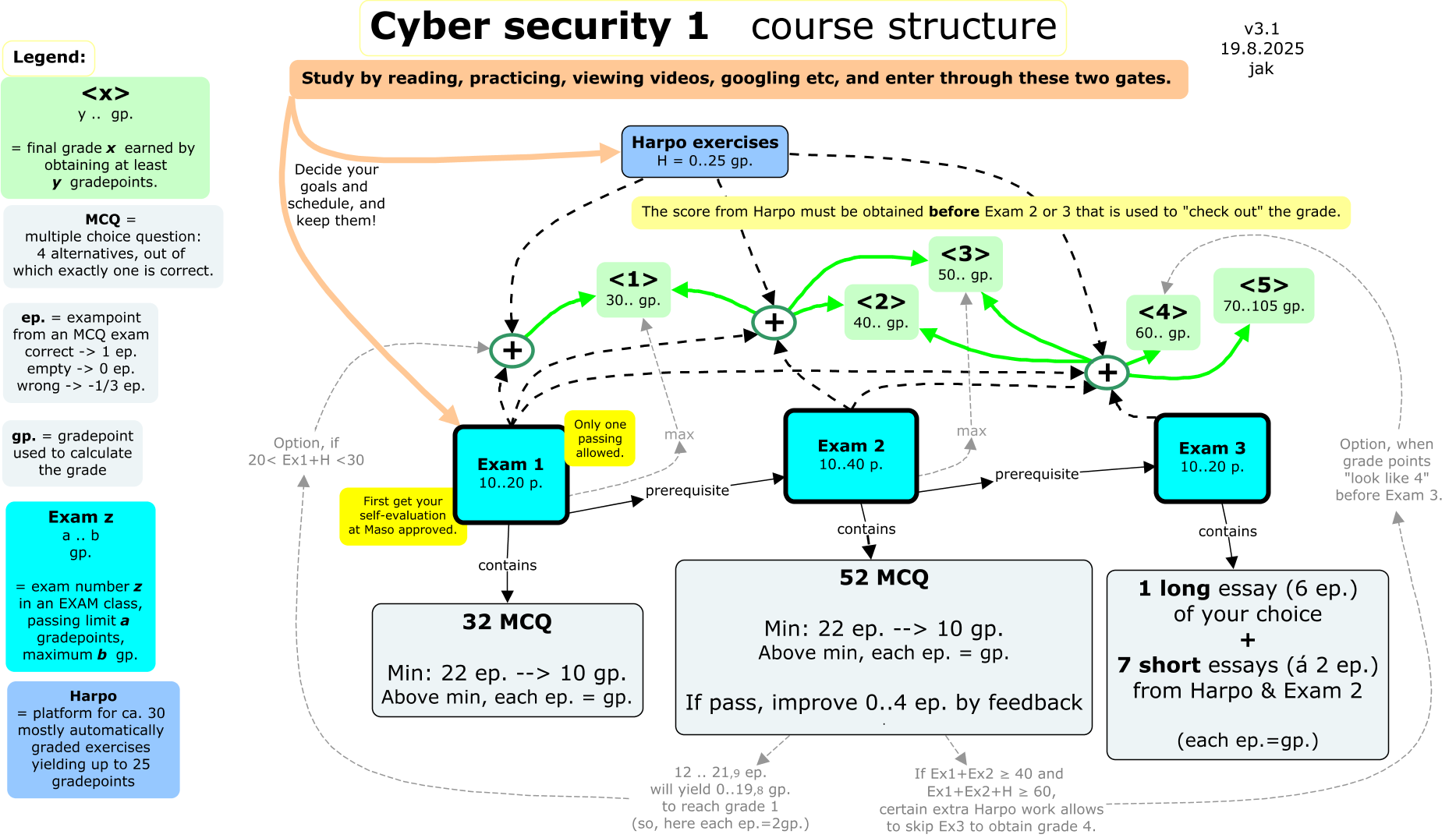
spatial learner, check the picture for requirements, and study the diagrams in "Maps and lists" for organization of most part of the course contents.
auditive learner, listen to some of the videos mentioned in section 5 of "Maps and lists" and find new ones, possibly available also in your own language.
social learner, read (and vote) and write (and edit) the two kinds of learning notes on Maso pages, write follow-ups to others' tweets in the News execise. If you spot someone working at the same time and in a similar fashion as you, ask the teacher to send your contact info to that pseudonym. The teacher is also aware of at least one WhatsApp group created by students on this course. Let the teacher know if you have a new group available there or elsewhere.
"careful" learner, or also a textual learner, do as instructed in the welcome message, which you can find on the Harpo main page next to this text.
If you don't know your style, you may first try with normal course instructions as suggested for the "careful" learner and then drifting towards such a style that feels good. For the case that nothing feels good, you should consult any study and well-being support provided by the university.
Introduction
This is the platform for Cyber Security 1 exercises: Please refer to the course handbook (v13, 25 Aug 2026.) for all arrangements of the course.
Next on this page: About the course with useful links.
New in 2026–2027
Participate in research about autonomy and motivation for 2 additional grade points!
Participation includes taking a separate research survey. In addition, your mandatory course self-evaluation, completed before the exam, and your course grade will be used as data for this research. Participation is voluntary, and it will give you two grade points. Please read research information and instructions and decide whether you want to participate. We really hope everyone takes part in this!
CTF exercises replace the old contributions exercise
You can still benefit from many contributions in Maso from the now discontinued exercise.
Equally many grade points, two, are now available from Capture the flag games. The CTFs run in PB212, a physical classroom in Hervanta, and you must reserve a time slot for it through this link. The first event is already in September, so check the schedule soon.
Each of the games, called “Who am I?” and "(Un)usual Monday morning", will bring you one point, and they will be independent from the Harpo exercise "Elementary hacking".
About the course
Please read the course handbook (linked above). The course structure is shown also in a diagram, and there is a calculator for the final grade. "Maps and lists" (v4.5.1 27 Nov 2025) may help when you gather knowledge from various sources for the exams — most notably the other course platform Maso.
A suggested schedule can help in keeping an order among the many bits of the course. You don't need AI for that, but here are the AI rules for this course.